User loginNavigationThe TheatreContentIF University at the Van Abbemuseum Archive In The Making IF Takes a Shower International Festival collaboration with BadCO.
International Festival StuffContact |
International Festival: Capitalism! BRING IT ON
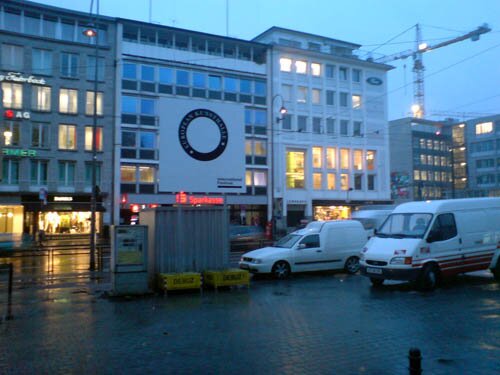
Capitalism! BRING IT ON, conceived for the Euopean Kunsthalle consists of three loosely connected parts reflecting how notions of public space has changed in our present time. The local cheerleading group GoldFlash will every Saturday activate the area of the Neumarkt Galerie shopping mall through a mixture of celebration and soft architecture, performing highly acrobatic choreographies and architecture like formations such as pyramids. A container equipped with a large sign of the European Kunsthalle will be placed on the Neumarkt proposing a different promise of a contemporary art institution. The local Kartell store is further engaged to function as the dressing room for teh cheerleaders, and in addition a publication will be assembled through a collabroation with Van Abbemuseum as a pro-active insertion into discourses around public-space, democracy and the empowering potentiality of culturalproduction. The project is supported by IASPIS (Swedish Arts Grants Committee).
Capitalism! BRING IT ON featuring GoldFlash Cheerleaders in Nuemarkt Galerie, Cologen. Saturdays 12.30 and 13.30, 3 March - 28 April. Cheerleading is everything! It’s sports, competitive but only rarely a means for competition, rather a particular social organization where coordination and trust is central. It’s a formation of temporary architecture producing geometries in space and configuring complex forms such as pyramids and cathedrals. It’s performance pushing presence to its limits and virtuosity sometimes over its boundaries. Cheerleading is pure spectacle, labor without an end-product, productive of nothing but intensity and interestingly enough an intensity that is in-autonomous in and of itself undermining its own identity. Cheerleading is fundamentally weak as its existence is dependant on another, oscillating between the implicit monstrosity of virtuosity, when bodies defy gravity and coordination, and the underdog position of servile labor, offering itself as non-productive, i.e. a labor without end-product. The voluntary alignment to an autonomous producer, e.g. a football team, proposes a critical relationship to authorship and identification. The cheerleading team proposes an alternative temporary space, or spatialization, that does not produce an inscription but instead is formulated as an entry-point. The lack of opportunity to articulate a sustainable identity and site of production in respect of the cheerleading team implies a possibility for activation in the viewer or spectator. Taking part of cheerleading, also as a spectator, suggest an experience of experience, detached from causality thus opening for the possibility of activation, of a different subjectification. Cheerleading as such proposes no object but act on the spectator in a corporeal manner, it is not first of all semiotic but address the spectator on levels of affect. Cheerleading is bungee jumping in reverse, instead of leading the spectator into a rush or wow-sensation, is giving permission for the spectator to take off on his own behalf. This in-autonomous production could on the one hand be understood as a failure in the production of space, but considering the differentiation of the public sphere it can also be read as the production of possibilities of oblique uses of always already occupied ‘public’ spaces. Cheerleading is a promise of a different use of seemingly continuous spaces, a promise that slides through junk space and instead complexifies spatio-temporal coordination. Cheerleading’s smile is not one of opportunism and obedience but is the agonistic smile a future that has yet to be given a name.
Notions and experiences of space shifts continuously through dynamics that only by means of vast generalizations can be understood as one, or over dichotomies such as e.g. private/public, inside/outside, real/imaginary, stable/temporary. On the other hand notions of space as heterogeneous and multiplying, where dichotomies are resolved can be a means to empower spaces and its users in new ways. Space is always violent offering the inhabitant or user certain potentialities of interaction and modes of production. This proposal aspires to invest in how these potentialities can be beneficial and empowering for individuals and groups in different ways. In inclusive global economies concepts of outside, avant-garde, resistance, critique etc. have been incorporated. There is simply no outside of capitalism, but instead of mourning what have been, what potentialities for life can new capacities offer. Can a diversified approach to new public and private domains give permissions to use of our environments in a pro-active way where e.g. commercial and non-profit economies are not juxtaposing or incompatible? |
 Capitalism! BRING IT ON